
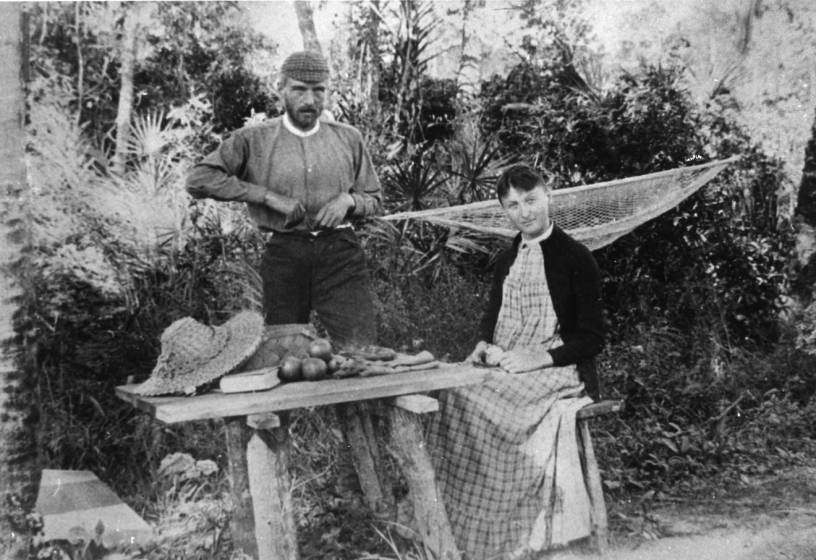
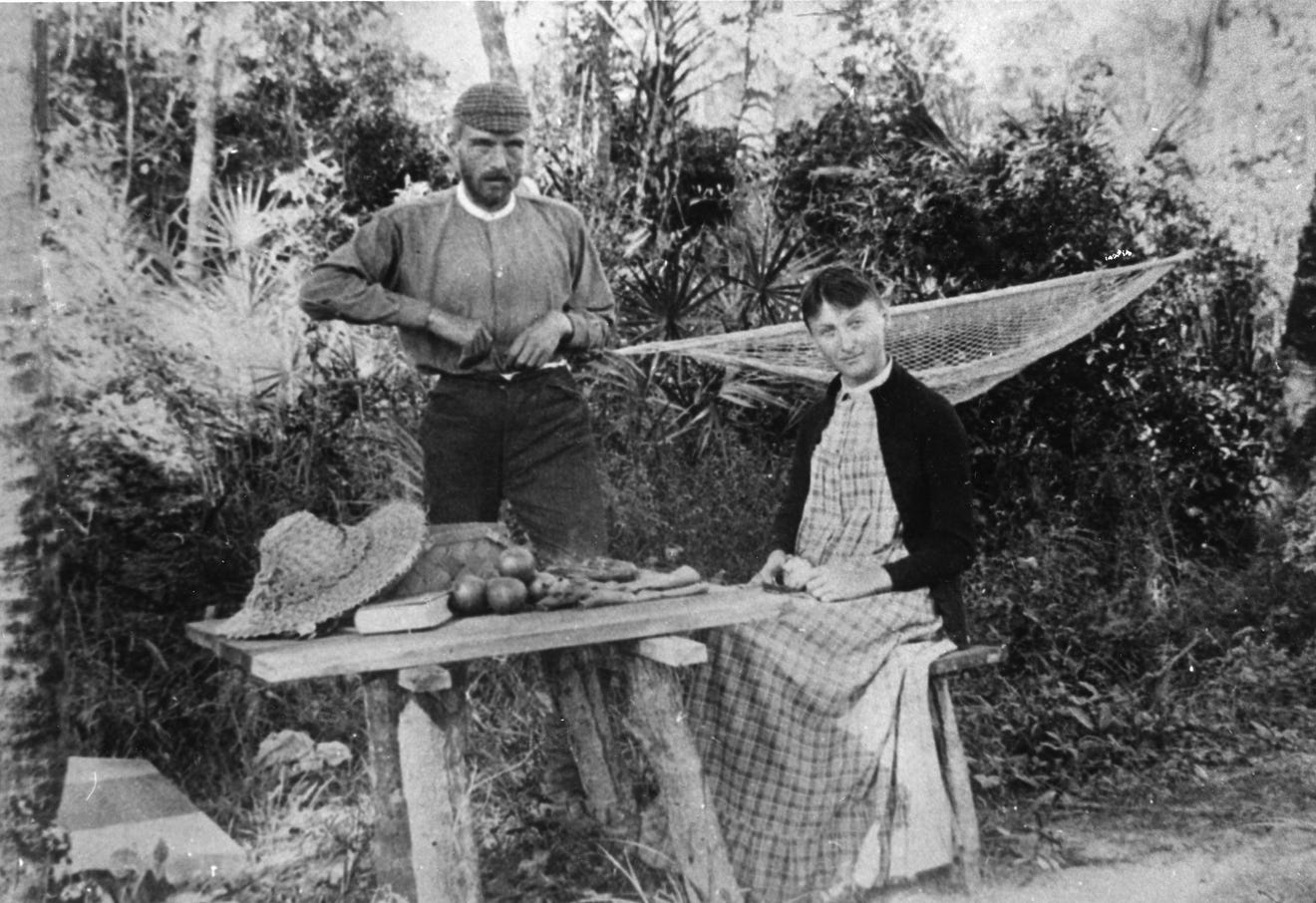
Anton Kleinsoscheg and his wife, Carrie Abbe, were early settlers in Southwest Florida. He wrote of the pioneering hardships, saying that the mosquitos were enough to drive one mead. (Photo Sarasota Historical Resources) https://www.heraldtribune.com/story/news/local/sarasota/2017/10/29/early-sarasota-settlers-overcame-hardships-to-build-community/17744341007/
An excerpt from HOME LIFE IN FLORIDA BY HELEN HARCOURT. Originally published by LOUISVILLE, KY. JOHN P. MORTON & COMPANY. 1889. Reprinted by Yesterday Press, Jupiter, FL, 2022.
“We pass by the flea, then, and pursue our investigations in another direction, looking next at an insect that causes far more annoyance than the wicked flea, not only in Florida, but in many other countries, in every State in the Union, and even up in the far-away Polar regions.
Mosquitoes, of course. There are some places in Florida where these tantalizing songsters are as numerous as they are in many of the coast regions or swamps of the sister States, and that is saying a great deal; but, again, there are other sections, notably in the high, inland pine regions, where they are practically unknown.
Just as they are North, South, East and West, during the summer season—troublesome after dark, when one sits out on the porches—so are they in Florida as a rule; this thing we know, we were more annoyed by mosquitoes in our Northern village home, than we have ever been in our far South home.
With ordinary mosquito-bars in the windows, and wirenet doors to keep the insects out when attracted by a light, and with a net over the bed, the “mosquito nuisance” becomes a very small one in the piney-woods home; we have known it to be a much greater one outside of Florida.
We wish we could say as much for the whole State; but truth compels us to confess that we have heard of localities in the hammocks and along the saw-grass shores of the large lakes, where double nets were used at doors and windows and over beds, and where the housewife, in making up her bread or cakes, was fain to wrap a gauze veil over her face for protection from a horde of hungry mosquitoes, who were anxious to make the most of her otherwise defenseless condition.
We have heard, too, of large, light frames, with nets stretched over them, under which the family sat to eat their meals, to read, or to sew; and these—were not in Florida.
The coast regions of Florida are very attractive in many ways; the dancing blue billows are glorious to look upon, and to sail over, the fresh salt air pleasant and invigorating, the fish and oysters and clams yielded up in generous abundance by the sparkling waters form no small items of home comforts; but—the mosquitoes!
They love the salt air too. From the beautiful, healthful shores of Charlotte Harbor comes the report, in response to our inquiries:
“We must confess that for several months of the year the mosquitoes are very trying; but we keep them at bay pretty effectually with nets in our doors and windows, and double nets over our beds. But this plague passes over; and all the rest of the year it is so enjoyable here that we forget the brief ‘reign of terror’ of the mosquito regime.”
And up from the Indian River country, on the opposite coast, a voice reaches us, the voice of a new Florida housekeeper:
“We are passing through an age of mosquitoes; they are almost unendurable for two or three months; yet we would rather have them, and do all our own work in addition, than deal with a willfully-obstinate ‘human,’ such as we have often encountered in South Carolina.”
[It is not only the Florida “cooks” that try one’s patience, you see.]
But, whether few or many, mosquitoes can be readily conquered by the use of the omnipotent insect-powder.
Putting a little of it in a paper cone, and setting fire to it, is one way to clear a room, not only of mosquitoes, but fleas and flies; puffing the powder toward the walls and ceilings is another way.
Still a third method of driving off mosquitoes is to place a piece of gum camphor in a tin cup, and hold it over a lamp until a vapor begins to rise (don’t let it take fire) and then wave the cup to and fro about the room until the air smells strongly of camphor.
We have found both powder and camphor very effective, though we have fortunately seldom been compelled to resort to them, and never except from carelessness in leaving windows open and unprotected, with a bright light in the room.
Even in the worst places in Florida, and during the height of the mosquito season, no one need be driven to the last resort of the natives of Lower Senegal. They go to roost, literally. During the several months when mosquitoes are on the war-path in deadly earnest, the unlucky human beings of that region are taught their own insignificance, and are compelled to retreat before their tiny foe. They set up regular roosts, or platforms, built on high forked saplings, reached by ladders, and floored with branches, and under these lofty platforms perpetual fires are kept burning; here the poor people have to live night and day, constantly enveloped in a dense smoke.
Squatted on their roosts they receive their friends during the day, passing hurriedly from one roost to the other, and never venturing out of range of the smoke, least they be eaten up alive; at night they stretch themselves on their platform, and sleep in the midst of smoke and warm air, with the stars above them and a fire below them. Query: Suppose the children should roll out of bed? It would be something like, “out of the frying-pan into the fire,” would it not?
And now, in bidding farewell to the mosquito question, we will quote from “Sketches of Travel in Singapore, Malacca, Java,” by a well-known German traveler, F. Jäger—an extract that will be found very useful to all hunters, whether Florida or otherwise, since they are sure to invade the haunts where mosquitoes ”most do congregate.”
“A tincture prepared by macerating one part of Pyrethrum roseum in four parts of dilute alcohol, and, when diluted with ten times its bulk of water, applied to any part of the body, gives perfect security against mosquitoes and all other vermin. I often passed the night in my boat on the ill-reputed rivers of Siam without any other cover, even without the netting, and experienced not the slightest inconvenience. The ‘buzzing,’ at other times so great a disturber of sleep, becomes a harmless tune, and, in the feeling of security, a real cradle-song. In the chase, moistening the beard and hands protects the hunter against flies for at least twelve hours, even in spite of the largely increased respiration due to the climate.”
You can purchase this book at Yesterday Press.

REPRINTED 2022: Prepare to be transported back to the pioneer days of Florida. This 1889 author presents the varieties of homesteading in Florida with candor, humor, and practical advice for the aspiring Florida pioneer. Learn how to farm, fish, build homesteads and furniture to put in the homestead. Learn how to deal with pests, mosquitos, alligators, and all of the other flora and fauna unique to the state. The author states, “Those who know Florida as she is, are those who love her best, and are most willing to tell the truth about her, without fear or favor.” In that she succeeds perfectly. This book is full of fascinating detailed information about life in Florida in the late 19th century.
From the original book (1889):
“It is not well to venture into unknown regions blindfold, as it were. That sound old admonition to “Look before you leap” is full of good common sense, and yet it is passed by unheeded more frequently than one can well realize.
We doubt if, in all the globe, there is any one spot concerning which more has been written, pro and con, than of our beloved Florida; much that is true, much more that is untrue.
We love Florida; of our fair State it may well be said that “to know her is to love her,” but we hold that her truest interests are best served by a plain statement of facts, not fancies; of realities, not theories; “the truth, the whole truth, and nothing but the truth.”
Not only throughout the United States, but in Europe, thousands of home seekers are eagerly turning their eyes toward Florida, and questioning as to what manner of life, what measure of comfort and success await those who elect to cast in their lot with hers. Those who come to Florida “to stay,” seek health, wealth, and a happy home, and these they will find if they are sought for in a reasonable, sensible spirit. We trust that when our readers lay down the pages of this book they will have gained a correct idea of Florida home life.”
CHAPTER I. WHAT FLORIDA OFFERS. Comfort and Competence for the Honest and Industrious. Increase of Prosperity, and Population of the State. Good Investment for both Capital and Labor. Health for the Invalid.
CHAPTER II. A BACKWARD GLANCE. Why Florida is called “A New Country.” A Glimpse of her History.
CHAPTER III. CLIMATE. Proved by Comparison and Statistics to be the Finest in the World. Scientifically ‘• Moderately Dry :” Variation of Temperature Just Sufficient for Health and Comfort.
CHAPTER IV. HEALTH. The First Consideration. Statistics Prove Florida to be the Healthiest State in the Union. Safe to Settle at all Times of the Year. Purity of the Air. Points in Locating : Water, Wells, and Filters.
CHAPTER V. TEMPERATURE. WINTER. SUMMER Violent Changes almost unknown. Mild Winters. Cooler in Summer than in the Northern States.
CHAPTER VI. PINE LANDS AND HAMMOCKS. Diversity of Soil and Surface. Relative Value in Productiveness and Healthfulness.
CHAPTER VII. “Where shall I Settle?” Northern, Middle (including West), and South Florida. Varied Products and Climatic Differences of the Several Sections.
CHAPTER VIII. “What will it cost?” Prices of Land: According to Location and Quality. Cost and Methods of Clearing Land. Solid and Increasing Value of a Bearing Orange Grove. Overproduction Impossible.
CHAPTER IX. MAKING THE HOME. Attractive Locations. Beautiful Water Views. About Windmills.
CHAPTER X. HOME SURROUNDINGS. Grass Lawns. Vines and Flowers. Shade-trees and Arbors. Shade for Poultry-yards.
CHAPTER XI. “WHAT SHALL I NEED?” Warm Clothing and Carpets Desirable. Cool Weather. “The Dark Days of January, 1886.” Whether to Bring or Buy in Florida the Household Furniture. Hints for Shipping Goods.
CHAPTER XII. “What Shall I Eat?” Deprivations in New Neighborhoods. The Provision Closet. Conveniences and Food Supply Constantly Increasing.
CHAPTER XIII. HOME SUPPLIES. Fish, Flesh, and Fowl to be had for the Catching. The Gopher Tortoise.
CHAPTER XIV. *’OUT OF THE DEPTHS.” A Boat the first Requisite. Methods of Fishing for Trout or Bass. Salt-water Fish, Clams, and Oysters. Methods of Catching Fresh-water Turtle; Curious Quality of their Flesh.
CHAPTER XV. THE DAIRY QUESTION — OLD STYLE. The Native Florida Cow. Methods of Milking. How to Make a Cowpen. Best Plan for best results in Fertilizing the Soil by Cow-penning. Treatment of the Florida Cow.
CHAPTER XVI. THE DAIRY QUESTION — THE COMING STYLE. Native Stock to be Improved by Crossing with Thoroughbreds and Proper Treatment. Acclimated Thoroughbreds should be Bought of Florida Breeders.
CHAPTER XVII. PASTURAGE. Bermuda, Johnson and Para Grass. Beggar’s Weed or Indian Clover.
CHAPTER XV. FLORIDA POULTRY. Nearly all Varieties do Well. How to Treat them Successfully.
CHAPTER XIX. THE POULTRY YARD. Shade, Grass, and Pure Water Requisite. The Nursery. How to guard against Hawks. Movable Coops and Fences.
CHAPTER XX. POULTRY PATIENTS. How to Treat the Few Diseases Florida Poultry are subject to.
CHAPTER XXI. FIRING THE WOODS. Permitted by Law for the Benefit of Cattle; but will soon be a Thing of the Past. A Most Pernicious Custom, Injurious to Soil and Property. How to Fight Fire.
CHAPTER XXII. ALL ABOUT FENCES. The Fence Law. Repeal Urgent. Injury done by allowing Stock to roam at Large, and compelling the Agriculturist to Fence against Them. How to Make Good and Cheap Fences. Wire Fences Made at Home.
CHAPTER XXIII. HOUSEHOLD HELP. Housekeeper’s Trials. Florida Negro Servants. Amusing Experiences. Importance of the Problem of Domestic Help. How it may be solved.
CHAPTER XXIV. TRIALS AND TRIBULATIONS. Insect Foes, and How to Eight Them. Harmless Lizards and Frogs. The “Bugaboo” of Snakes.
CHAPTER XXV. MAKING THE BEST OF IT. Compensations for Drawbacks. How to Make the New Home Happy.
CHAPTER XXVI. HELPFUL HINTS. How to Paint Houses. Recipes for Cheap Paints. About Horses, “Wagons, and Harness. How to Renovate Carriages. Home-made Furniture, Rugs, and Refrigerators. To Preserve Food.
THE AMATEUR HOUSE PAINTER. MILK PAINT. ANOTHER DURABLE PAINT. FIEE-PROOF PAINT. THE HORSE AND ITS ADJUNCTS. TO PRESERVE HARNESS. HOME-MADE FURNITURE. BED-ROOM FURNITURE. THE ROSS NOVELTY RUG MACHINE. THE BARREL CHAIR. A HOME-MADE REFRIGERATOR.
 Exploring Florida History