
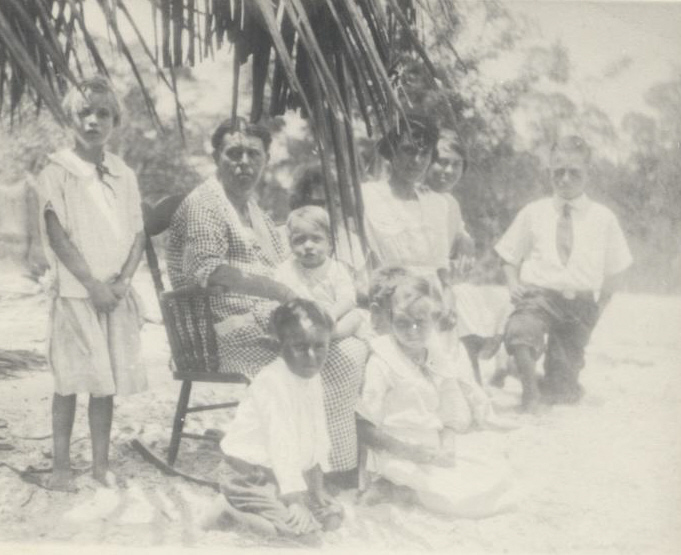
During the Great Depression years, the residents of the Ten Thousand Islands in the Florida Everglades survived and flourished. They had an abundance of fish, wildlife, and produce from their gardens. The children played and fished and did chores. They were taught to read and do a few sums but for the most part they reveled in life on the water and in the swamps.
Excerpted from Lostmans Heritage: Pioneers in the Florida Everglades by Karen Yvonne Hamilton
All content here is copyrighted. Please give proper credit if sharing and/or referencing.
Chores & Child Rearing
Memoirs of Ernest Hamilton, youngest son of William ‘Buddy’ Hamilton, grandson of King Gene
“Mama (Florinda Gomes Hamilton) would carry buckets of freshly made syrup from the refinery to the assembly building where the syrup was canned and made ready for market. She worked on the farm to help with the harvest of all sorts of vegetables and fruit, including bananas and avocados. She, of course, also participated in the cooking and tending to the young’uns.
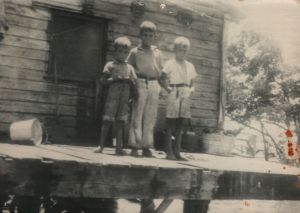
My mama did her share around the place. She boiled clothes in a big black pot, jabbing at them with a stick to keep them stirred. She chipped an Octagon soap bar into the brew until the suds were foaming. After a while she would pick the clothes out of the pot with the same stick and throw the clothing over a clothesline. After the clothes were cooled off a bit, she would wring them out and hang them proper on the line. Once they were dry, she’d fold them and put them away. This chore, on more than one occasion, included the clothes of others in the clan.
Our folks wanted their shirts and pants ironed when they went into town. The tool of choice was a piece of iron shaped like a boat and flat on the bottom with a handle on top. It would be placed on the stove to heat and then picked up using a rag to grasp the handle and then applied to the garment. Needless to say, if the iron was not constantly in motion, the material would sport a brand-new hole to be patched.
Bill (Parker), my step-father, also dispensed gas to the fishermen. One day my brother, Francis, found the gas hose and sucked on it. He passed out and Mama thought he was dead. He revived only to get his rear-end whacked good and proper and admonished to keep his paws, and mouth, off things not concerning him.
Wallopings in those days were the order of the day. Children then as today took their chances and did some things they were not supposed to do. When they got caught, they knew what to expect. Another rule for children then was, and I heard it many a time, ‘children are to seen and not heard’.”

Memoirs of Paul Gomes: Son of Salvador Gomes and Rosalie Hamilton, grandson of King Gene
“Water for bathing, cooking, and laundry. About once a week you had a #3 washtub, all the kids go in the washtub, you use the same water cause water was like gold. A lot of people, including my mother, took what we called a ‘whore’s bath’ you know, underneath the arms.”

Schooling
Memoirs of Paul Gomes: Son of Salvador Gomes and Rosalie Hamilton, grandson of King Gene
“My daddy was a fisherman, and what you did as a fisherman, you followed the fish. Different seasons there’s different fishes and they’d move up and down the coast. So, in the wintertime, a lot of times, we’d go to Marathon. I went to school in Marathon, in the Susan B. Moore school. They’ve got a big statue of her, what a bitch. She failed me two grades in a row, and when we finally left there and moved back to the Everglades, the teacher said, “This is sinful. What are you doing in my class?”
She moved me up to the 2nd grade, then she moved me to the 3rd grade, then she moved me up to the 4th grade. She says, “I don’t know what that woman was thinking about.”
I said, “I do! The bitch didn’t like me.”
So anyway, the fish, we moved up and down the coast. We’d go down in the winter, winter in Marathon. Daddy’d fish out of there. Then the summer, we’d come back and fish all of Lostmans River, and then when school started, Daddy’d go up to Everglades, and I’d go to school, me and my brother and sister would go to school. And then, soon as we got out of school, like for Christmas or whatever, we’d go back to Lostmans River. Like nomads, right? It was an interesting life. We would get books from the Catholic church in Key West, and I’d study those. Until we started going to school in the Everglades, on the lighter.”



Memoirs of Ernest Hamilton, youngest son of William ‘Buddy’ Hamilton, grandson of King Gene
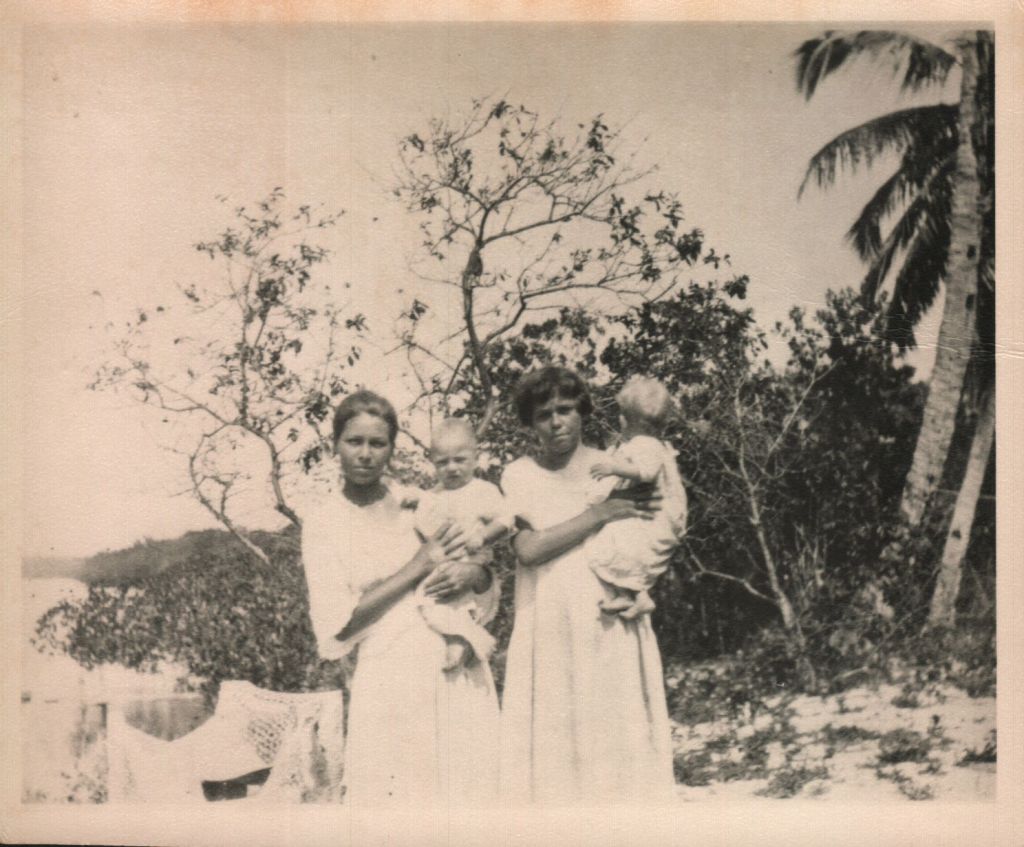
“The story has it that my father, William “Buddy” had a brilliant mind. Of course, everything is relative. He may very well have been smarter than the average trooper in that area. The settlers brought in a teacher from the mainland when William was a teenager. He learned everything the teacher had to teach in a short time and the teacher told him, “I can’t teach you anymore, you’ve got all that I have.”

“I began school at the Iona school on McGregor Boulevard. The school is about two miles, more or less, from our house in a southerly direction. It is a small brick building and looked then quite like it does today. Our route to the school, and I believe we walked it, began on our old dirt or shell rock road, across the farm, across the first paved road, continuing south until we reached McGregor, then west to the school. The school contained two, rather large, classrooms. One for high school students and the other for all the rest. In the middle of the room was a potbellied stove, which used wood for fuel. In the winter it always held a pot of boiling water, to provide humidity, I reckon.
One day they had some sort of festival. All the young ladies in high school baked pies, which were to be auctioned. The young high school boys were supposed to be the bidders. Junior liked one little gal pretty particular, and he bid a whole dollar for her pie. I believe he won. I don’t know where he got such a sum to pay off. If Bill had to pay, I’m sure Junior got a licking for it.
There was one time, shortly after I had begun school, when we had homework. We were supposed to study a list of words for a spelling test the next day. I thought we were supposed to memorize them. I did, and when the teacher told us to prepare to take the test, I wrote them all down. She was amazed. I spelled them all correctly too. I always was a good speller. That is my only visible and known talent.”

Lostmans Heritage: Pioneers in the Florida Everglades follows the author’s journey as she searches for her ancestors from the slave country of Savannah to the wilds of Ocala and Arcadia, Florida, and deep into the Florida Keys and Everglades. This true story begins with Hamilton’s ancestor, Richard Hamilton, who was first introduced to the world in Peter Matthiessen’s novel, Killing Mr. Watson. Hamilton’s research follows Richard, a former slave, and other Everglades residents to the ending of an era when the National Park Service took over the islands. Along the way Hamilton uncovers secrets and stories, polygamy, bootlegging, fist fights, murders, gangsters, killers, and tales of tomahawks and missing schoolteachers. The Everglades was not a place for the average man at that time. You did what you had to do to feed your family.
FLORIDA KEYS HISTORY FACEBOOK GROUP: Consider joining our group for more on Florida Keys History.
FLORIDA EVERGLADES HISTORY FACEBOOK GROUP: Consider joining our group for more on Florida Keys History.
 Exploring Florida History