by Karen Yvonne Hamilton, 2024; latest update November 15, 2026
On September 10, 1886, fourteen-year-old José García Bello stepped ashore in Key West carrying far more than a small bundle of belongings. He carried the memory of Havana, the grief of a family marked by loss, and a quiet determination that would shape the next sixty-four years of his life.
Born on November 17, 1871, in Havana, Cuba, José entered a world alive with political unrest and cultural pride. His father, Juan GARCIA De Casuso (Orasua) (1830-1881), had already experienced decades of colonial Cuba’s uncertainty. His mother, Maria de Jesus BELLO De Nunez, died when José was still a child, leaving him to grow up amid the changing fortunes of an extended family whose story stretched deep into Havana’s history. His father would die in 1881, leaving José an orphan before he reached his tenth birthday.
Beginning in 1891, José started recording events in notebooks that he continued until 1904. He did not simply write about his own daily life. Instead, he reached backward in time, adding entries that documented important family events and significant moments in Cuba’s history. His journals reveal a man who understood that memories disappear unless someone makes the effort to preserve them. Long before historians valued everyday voices, José was quietly creating a family archive.
On August 26, 1881, Jose wrote about his relative Tranquilino Bello, who fought a duel against Desiderio Castellanos. Such affairs of honor, though increasingly uncommon, still captured public attention in nineteenth-century Cuba. The duel ended in tragedy when Tranquilino was killed. Although José was only nine years old, the event left such an impression that years later he carefully recorded it in his diary, preserving the memory for future generations.
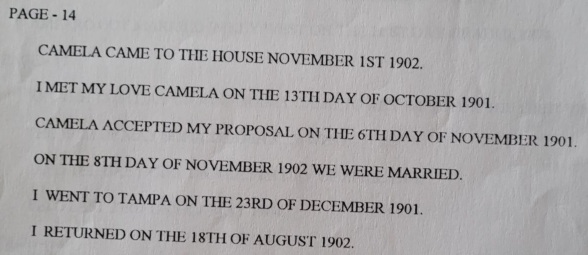
He kept a diary that spanned from 1891-1904 and backdated some entries to include important events that took place in Cuba. One entry relates a duel between Tranquilino Bello and Desiderio Castellanos on August 26, 1881 in which Tranquilino was killed.(SEE FULL DIARY as a downloadable PDF).

By the time he began writing, he had already made one of the most important journeys of his life.
In 1886, Key West was booming. Thousands of Cuban immigrants had transformed the island into one of the world’s great cigar manufacturing centers. Spanish filled the streets, Cuban newspapers circulated daily, and political debates about Cuba’s independence echoed inside the cigar factories where lectores read aloud while workers rolled tobacco.
José arrived in this remarkable community as another young immigrant seeking opportunity.
Like many Cuban exiles, he found work in the cigar industry. The craft required patience, dexterity, and long hours, but it also placed workers at the intellectual center of Cuban-American life. Every day they listened to novels, newspapers, and political speeches while their hands transformed tobacco leaves into fine cigars shipped throughout the world.
Jose worked as a Lector (a reader) for the La Rosa Cigar Factory (La Rosa Española). La Rosa was destroyed in the Great Fire of 1886 and rebuilt by Vicente Martínez Ybor. In 1894, the factory was relocated to Tampa, building a massive 35,000-square-foot brick factory in Ybor City.
For fifteen years José built a life between two worlds.
MARRIAGE
For fifteen years José built a life between two worlds. Then, in 1901, he returned to Havana.
He reports in his diary that he married Maria Carmen Amparo RODRIGUEZ (often called Camela) on November 8, 1902 in his hometown. Maria Carmen’s Declaration of Intention to become a US citizen report the marriage as June 28, 1901. As she only spoke Spanish, it is possible that the declaration was filled out by someone else who misunderstood her. For genealogical purposes, I treat Jose’s diary as a primary source. As a lector, he was well read and educated. Their marriage united two Cuban families despite the ninety miles of water that separated Havana from Key West. Like countless Cuban families of the era, theirs would become an international household long before such arrangements became common.
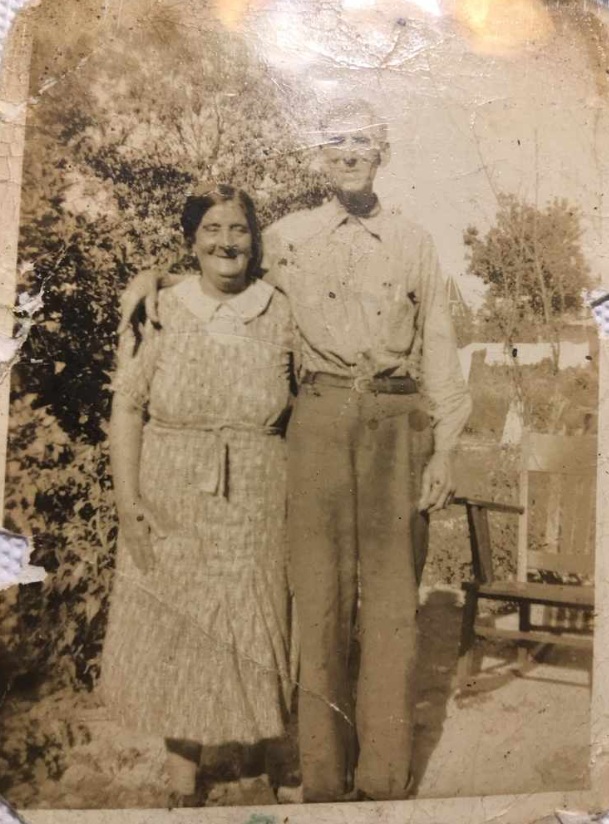
The following year Carmen traveled north aboard the S.S. Olivette, arriving in Key West in 1902 to join her husband. They had five children: Blanca Rosa, Candido ‘Beby’, Carmen, Jose Evelio, and Elio.

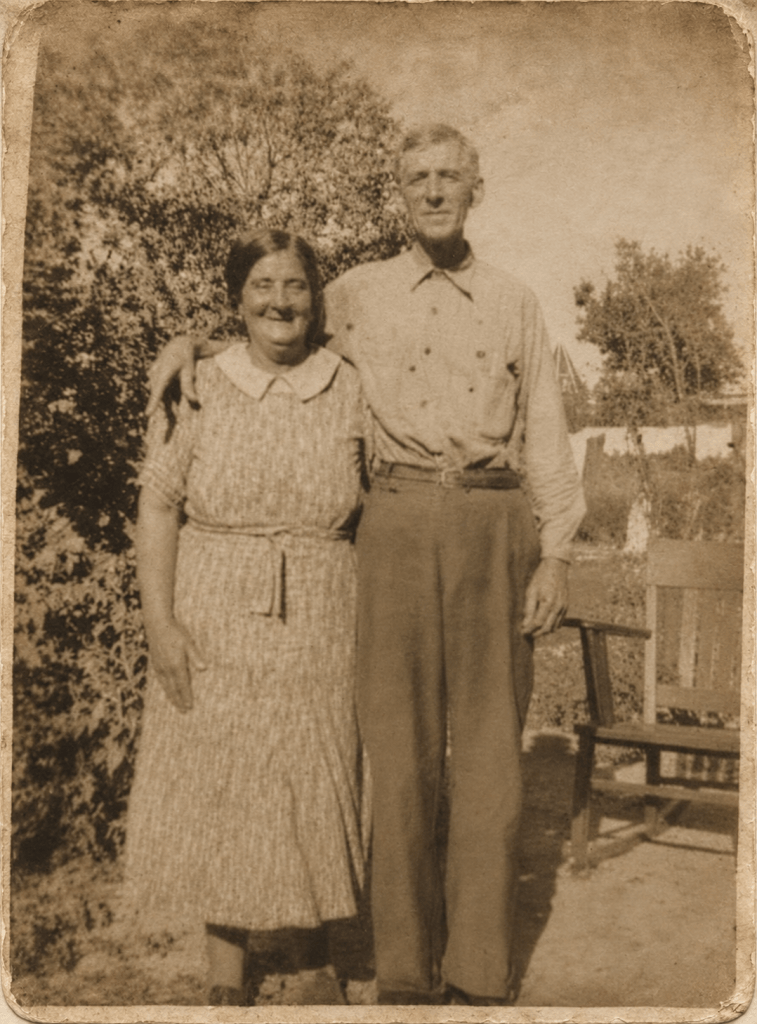

The family grew alongside the city itself.
By 1914, José and Carmen lived at 809 Catherine Street.

By 1920, they had moved to 615 Simonton Street, where the federal census captured a fascinating snapshot of immigrant life. José continued working in a cigar factory, the occupation that had sustained him for decades. Remarkably, after more than thirty years in the United States, he still spoke no English. Spanish remained the language of the home, the neighborhood, and much of Key West’s Cuban community.
They lived with their children, Blanco, Candido, Carmen, and Evelio. Only two members of the household—daughter Carmen and son José Evelio—reported speaking English.
The census reveals not isolation but confidence in a community where one could live an entire life surrounded by fellow Cubans. Newspapers, churches, businesses, schools, and cigar factories all operated comfortably in Spanish. Key West was not simply an American city with Cuban immigrants; it was, in many ways, a Cuban city on American soil.

Yet the family never severed its connection with Cuba.
Steamships crossed the Florida Straits with remarkable regularity, and José made frequent journeys back to Havana over the years. Some trips were undoubtedly visits to relatives. Others may have involved business or simply the desire to remain connected to the place where every important childhood memory had begun.
One documented voyage occurred on October 24, 1925, when fifty-four-year-old José sailed from Havana to Key West aboard the SS Cuba, accompanied by his nineteen-year-old daughter Blanca. One can imagine father and daughter standing together on deck as the island disappeared into the distance, discussing family members left behind and those waiting in Key West.


By 1930, the family had settled at 511 United Street, renting their home for $14 a month, a modest sum even during the difficult years that would soon become the Great Depression.

Later they moved again.
The 1935 and 1940 censuses placed José, Carmen, and their son Elio at 1017 Simonton Street, another address in the heart of Key West’s Cuban neighborhood. Although decades had passed since his arrival as a teenager, José remained what he had always been—a cigarmaker whose skilled hands earned a living while his heart remained tied to two countries.


DEATH
On June 2, 1950, at the age of seventy-eight, he died of heart failure. His death certificate still listed his occupation as cigarmaker, testimony to a lifetime spent at the workbench and as a lector. He was living at 5D Porter Place with his wife Carmen and daughter Blanca. Next door lived the George Knowles family at 5C Porter Place, a reminder of the close-knit neighborhoods that defined old Key West.
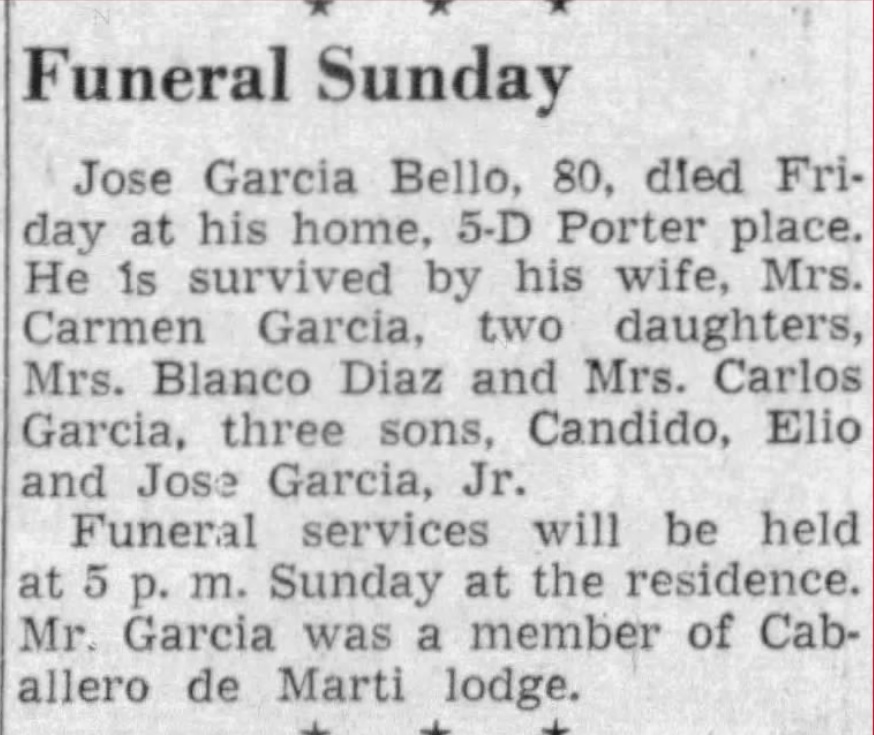
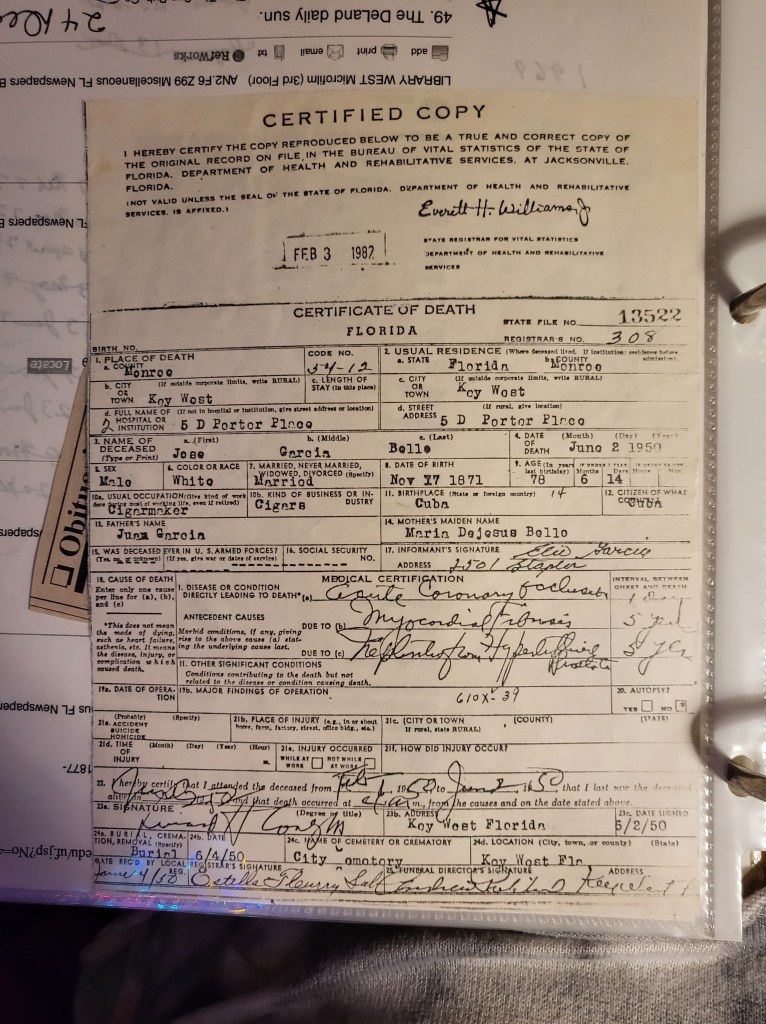
José had crossed the Florida Straits as a teenage immigrant with little more than hope. Over the next six decades he built a family, raised five children, worked faithfully in the cigar industry, and remained devoted to both Cuba and Key West.
Yet perhaps his greatest legacy was not found in the census records or city directories.
It was found in his diary. Those handwritten pages, kept between 1891 and 1904, transformed ordinary family memories into history. By recording not only his own experiences but also earlier events—like the tragic duel that claimed Tranquilino Bello’s life—José ensured that future generations would know the names, stories, and sacrifices that might otherwise have vanished.
Today, more than a century later, his careful habit of writing allows descendants to hear his quiet voice across time.
Every family historian hopes to find an ancestor who preserved the past. For the García Bello family, that ancestor was José.
SOURCES
Research files of Jane GARCIA Rowland, diary entries 1891-1904, Key West Directory 1914, Ancestry.com; Personal recollections; 1920 United States Federal Census; 1930 United States Federal Census; Florida Divorce Index, 1927-2001; Florida Marriage Collection, 1822-1875 and 1927-2001; Florida Passenger Lists, 1898-1964; Florida State Census, 1867-1945; Florida, Naturalization Records, 1847-1995; U.S., World War II Draft Cards Young Men, 1940-1947; Web: Florida, Find A Grave Index, 1800-2012
ANCESTRY WORKSHEET last updated November 15, 2026 by Karen Yvonne Hamilton
| Supporting Document | |
| Jose Garcia BELLO | |
| FATHER: Juan GARCIA De Casuso (Orasua) (1830-1881) | Death certificate State of Florida Vital Statistics |
| MOTHER: Maria de Jesus BELLO De Nunez (1831-1859) | Death certificate State of Florida Vital Statistics |
| Birth Date: November 17, 1871 | Death certificate State of Florida Vital Statistics |
| Birth Location: La Habana, Cuba | Death certificate State of Florida Vital Statistics; oral family history |
| MARRIAGE & CHILDREN | |
| SPOUSE: Maria Carmen Amparo RODRIGUEZ | OBIT The Miami Herald Miami, Florida Saturday, June 03, 1950; Ancestry.com. U.S., Social Security Applications and Claims Index, 1936-2007; 1920 United States Federal Census; 1930 United States Federal Census; 1940 United States Federal Census |
| Marriage Date: June 28, 1901 Cuba OR Jose Garcia Bello’s Diary 1891-1904 lists November 8, 1902 as their marriage date. | Declaration of Intention to become a US citizen (Maria Carmen); Marriage Certificate, Habana, Cuba; Jose Garcia Bello’s Diary 1891-1904 |
| CHILDREN: Blanca Rosa Bello Garcia 1907–1982; Candido ‘Beby’ Garcia 1909–1993; Carmen Garcia 1913–1995; Jose Evelio Garcia Bello 1917–2009; Elio Garcia Bello 1923–2001 | OBIT The Miami Herald Miami, Florida Saturday, June 03, 1950; Ancestry.com. U.S., Social Security Applications and Claims Index, 1936-2007; 1920 United States Federal Census; 1930 United States Federal Census; 1940 United States Federal Census |
| RESIDENCES | |
| (1886) Key West | Florida Passenger Lists, 1898-1964 |
| (1914) 809 Catherine Street Key West, Florida | Key West City Directory 1914 |
| (1920) 615 Simonton Street Key West, Florida | 1920 United States Federal Census |
| (1930) 511 United St. Key West, Florida | 1930 United States Federal Census |
| (1935) 1017 Simonton Street Key West, Florida | 1940 United States Federal Census |
| (1940) 1017 Simonton Street Key West, Florida | 1940 United States Federal Census |
| (1950) 5D Porter Place Key West, Florida | 1950 United States Federal Census |
| DEATH | |
| DEATH Date: June 2, 1950 | Death Certificate; OBIT The Miami Herald Miami, Florida Saturday, June 03, 1950; Florida Death Index, 1877-1998 |
| DEATH Location: Key West, Florida | Death Certificate; OBIT The Miami Herald Miami, Florida Saturday, June 03, 1950; Florida Death Index, 1877-1998 |
| BURIAL: Key West, Florida | Family Oral History |
FLORIDA KEYS HISTORY FACEBOOK GROUP: Consider joining our group for more on Florida Keys History.
FLORIDA EVERGLADES HISTORY FACEBOOK GROUP: Consider joining our group for more on Florida Everglades History.